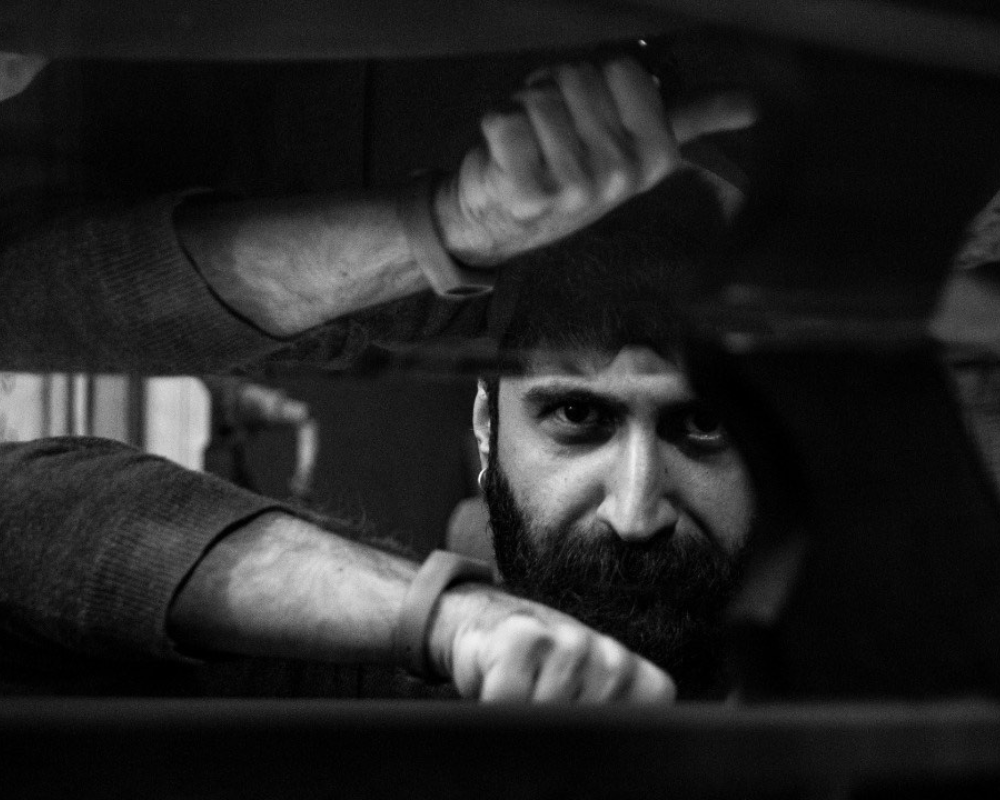
Hi Pouya, thanks for agreeing to answer a few question for Fluid Radio. To begin with, could you tell us a bit about yourself? You are a musician, producer, composer, multi instrumentalist, sound artist, and actor. Which came first and how do each of these different practices inform each other?
I have been in the music field since my childhood and I have also been active in theatre for ten years. I think in order to answer your question it’s better that I start from my childhood. I grew up in an artistic atmosphere since my parents were both theatre artists. I also started studying music from then and because of my grandfather’s recommendation. We had an interesting library at home when I was a child and my mum and my grandfather were my encouragements for reading literature. So I could say that my childhood memories are mostly filled with different books and a love of literature in general. In my opinion music has an abstract instinct and as a result it’s not as expressive as literature or theatre. I noticed this fact when I had become a musician and I was busy with composing music. I needed to express myself beyond music and that’s why I started using literature in my music albums. In addition, I could say that working in theatre is also another way for me to fulfil my need for expression.
In terms of your musical background, you play double bass, and I imagine you have classical musical training like your friends Sara and Nima from 9T Antiope? Also, I understand you were all part of the Camerata Theran Orchestra under Kayvan Mirhadi?
Such a good question because Keyvan Mirhadi has an important role and a big influence on my understanding of music, art and life in general. I was first his student in Harmony and Music history and then I played in his Orchestra “Camerata” for ten years. And Yes this is the way I met Nima and Sara since we all played in Camerata orchestra. I learnt a lot from Mirhadi and especially about contemporary classical repertories.
How did you get into drone-ambient music and how do you integrate your double bass training into electronic music? Also, what is your current studio setup and your favourite piece of gear? And how do you approach a live performance?
It is complicated for me to answer this question since I have started composing music for quartets or string orchestras, for sure one of the reasons could be that there is work for professional players or orchestras for such music. But in my opinion this is not the main reason I began to play double bass. I think the main reason I got into drone-ambient music is due to my musician friends and colleagues who had influenced me in this field. For instance working and cooperating with Nima Aghiani and Siavash Amini for such a long time for sure had great influence on me.
https://soundcloud.com/pannulus/quartet-for-water-earth-wind
As for my studio I have a very simple set up, a small room, a sound car, computer, and monitors. I like to use instruments in my live performances and for that the software I use is Ableton. One of my favourite pieces of gear is a TLM 103 microphone.
What was the inspiration behind your album Prison Episodes? I believe you are a Jorge Luis Borges fan, did his narrative style inspire the way the album is constructed and could you say something about its episodic structure?
Choosing this concept has many reasons for me. Some of the reasons are personal and I don’t want to talk about them. My previous album “Lalaei/Lullaby” also had come out of the same concept. I could relate it again to my childhood and adolescence and my interest in literature. As I mentioned before I have always been interested in Iranian contemporary poets, such as Shamlou. For instance one of Shamlou’s poems that had a great influence on me for choosing this concept is called “The Penalty / Here there are four prisons / In each prison several tunnels, in each tunnel several quarters, in each quarter several men in chains …” Or I could bring other literary examples focusing on the same subject such as Masoud Sa’d Salman or Borges as you said. But I should also say that I was not inspired by Borges in form or music. And about the episodic form of the album I could compare it to theatre in the Aristotelian way of narrating. I have tried to recreate this theatrical form in my music. As I said before music could not express itself comparing to literature, so I used words in this album to complete this expression and I considered each track (piece) as a part of this linear narration.
On the theme of incarceration, one of the first things that came to my mind, was the work of Forensic Architecture https://forensic-architecture.org/ who work with audio analysis and acoustic modelling and have studied the way sound shapes the experience of many prisoners. Does your album in any way reflect similar concerns?
As I mentioned before I have tried to tell a story through my music. Therefore I have looked at the whole album as a story writer or let’s say a theatre director and I have used personal and also historical experiences while composing.
The artwork for Prison Episodes is by Barbad Golshiri and references the prison memories of A’ezam, a political prisoner of the 1980s, as retold by Akbar Sardouzami. As the liner notes tells us, the text reads: ‘A’ezam has been degraded and tortured, living in timelessness and facelessness. She has nothing, and has turned to nothing, she says. Then one day she finds a rusty pin in her solitary confinement. She starts to draw squares, and the squares become her world: ‘Then I saw if I draw a square within another square and reach the depth, the square turns to a point. The cell was too dark, but I could see a point in the middle of the square that helplessly looked up at me and said: you should testify that I’ve been a square. You are the only one who knows that I have been and still am a square.’ The sound of the album is certainly harsh and abrasive, even mournful, but it’s not relentless, there are suspended moments of light within the darkness floating in clouds of reverb. You’ve not just gone for distorted electronic tones, but you’ve included violin/viola and trumpet from Adel Poursamadi and Sardar Sarmast to give a more organic feel. It is possible to retain some level of hope in our current times?
Barbad is one of my old friends. I had seen this artwork in one of his exhibitions about nine years ago. And I could say it was so special for me from the very first moment and it remained in my mind since then. After finishing the album I consulted with Barbad for the album. He had another suggestion in the first place. But Kate convinced us both to change the first decision. (I have to confess that Kate helped a lot cause I don’t know the European audience that well). So Barbad finally suggested this piece and of course it made me deeply happy for so many reasons.
In the album I position the trumpet and the stringed instruments almost in the role of characters themselves. It is difficult to know what to say about hope. Even in difficult times it can be found in unlikely places, or perhaps when you do not expect it. Perhaps in this album it may be possible to also find some hope.
Read more
https://www.fluid-radio.co.uk/2019/07/interview-with-pouya-pour-amin/